Conference Abstract
Multi-omic analysis reveals the unique glycan landscape of the blood-brain barrier glycocalyx
Reid Larsen1,2, Krzysztof Kucharz3, Sidar Aydin1,2, Mariel Micael2, Biswa Choudhury4, Mousumi Paulchakrabarti4, Micael Lønstrop3, Jordan Lin1,2, Markus Abeln5, Anja Münster-Kühnel5, Martin Lauritzen3, Jeffrey D. Esko4,6, Richard Daneman1,2
Affiliations
1. Department of Pharmacology, University of California, San Diego. La Jolla, CA, USA.
2. Department of Neurosciences, University of California, San Diego. La Jolla, CA, USA.
3. Department of Neuroscience, University of Copenhagen. Copenhagen, Denmark.
4. Glycobiology Research and Training Center, University of California, San Diego. La Jolla, CA, USA.
5. Institute of Clinical Biochemistry, Hannover Medical School. Hannover, Germany.
6. Department of Cellular and Molecular Medicine, University of California, San Diego. La Jolla, CA, USA.
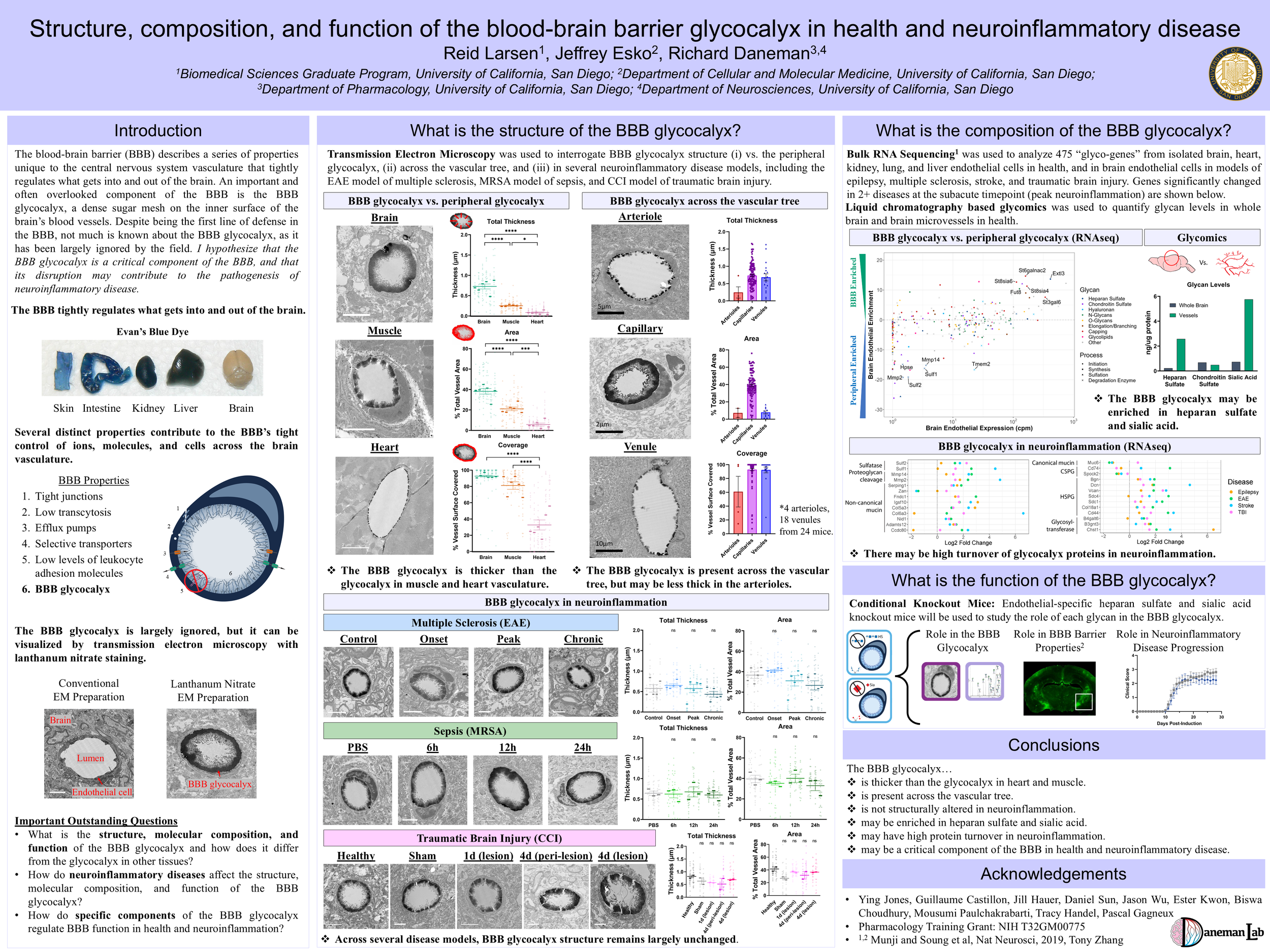
The blood-brain barrier (BBB) glycocalyx is the dense layer of glycans and glycoconjugates that coats the luminal surface of the cerebral vasculature. Despite being the first point of contact between the blood and brain, not much is known about the BBB glycocalyx. Here, we show that the BBB glycocalyx is highly distinct from glycocalyces in the peripheral vasculature. Improving upon previous electron microscopy methods, we show that (i) the BBB glycocalyx is significantly thicker than glycocalyces in the peripheral vasculature, (ii) its structure remains relatively uniform across the vascular tree, and (iii) the presence of hyaluronan is critical for its structure. Using a novel glycomics approach, we find that the BBB glycocalyx is enriched in sialic acid and chondroitin sulfate compared with kidney and liver glycocalyces. Using endothelial RNA sequencing, we identify potential genetic determinants for these differences, including BBB enrichment of genes involved in sialic acid addition and peripheral enrichment of Tmem2 and Hyal2, the genes encoding the only known cell-surface hyaluronidases.
The BBB glycocalyx acts as a molecular sieve, but we find that its degradation is not sufficient to alter BBB permeability in health, so the primary barrier function of the BBB glycocalyx may be to regulate access to the brain endothelium. Contrary to previous studies, we show that the neuroinflammation that accompanies the experimental autoimmune encephalomyelitis (EAE) model of multiple sclerosis leaves the BBB glycocalyx largely unchanged, even at sites of active leukocyte extravasation. Moreover, genetic removal of brain endothelial sialic acid causes delayed onset of paralysis in EAE. The unique structure and composition of the BBB glycocalyx suggest specialized functions, yet its resilience in neuroinflammation highlights the need for further investigations to unravel its heterogeneous roles and contributions to BBB physiology and pathology.
Poster